HELIX Observatory

Look up a wallet address

Paste a wallet address to see its Genesis records and team.

Questions? Message Xiaoming here
HELIX protocol · Pending launch

Project overview · The HELIX Guide

Protocol sets the boundary.Market finds the equilibrium.

The Genesis Plan raise is complete; the HELIX protocol has not launched yet. Before it does, learn how this dual-helix economic machine works: where the boundaries come from, and where the capital goes.

Individual rationality does not add up to a sustainable system.

The market

Freedom

Markets are good at finding efficiency, but setting boundaries is not their job.

The protocol

Order

Protocols are good at setting boundaries, but they cannot discover prices for the market.

Can one economic system
have both freedom
and order?

The coordination paradox

Not either-or.
Layers.

Boundaries at the macro level, freedom at the micro level.

Economic Expansion ≤ Economic Capacity

The protocol only sets the boundaries on total supply, speed and risk; it does not place each unit of capital for the market. Inside those boundaries, the market is free to find price and direction.

AI creates value,
HELIX organizes it,
AiLGNS connects it.

In AWAKE's second phase, artificial intelligence is the most important core ecosystem business. AI creates real demand and services; HELIX handles metering, emission, liquidity and governance.

  1. A holographic glass AI workstation with a robot assistant in the middle of the screen

    Model provides intelligence

    AiLGNS One

    Global AI aggregation workspace

    Brings models, knowledge, tools, workflows and agents together into one AI entry point for individuals and businesses.

  2. Agent nodes orbiting the Earth

    Agents create services

    AiLGNS Agents

    Global agent service network

    Gives specialist agents recognizable capabilities so they can find, call and work with each other on complex tasks.

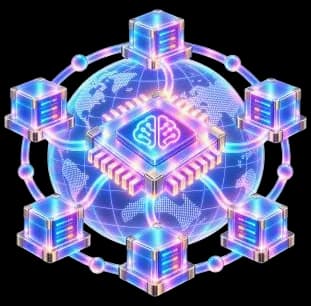
  3. A chip and the Earth surrounded by compute blocks

    Compute provides processing power

    AiLGNS Compute

    Global AI compute network

    Connects cloud platforms, GPUs, data centers and qualified nodes so mixed compute can be scheduled and metered.

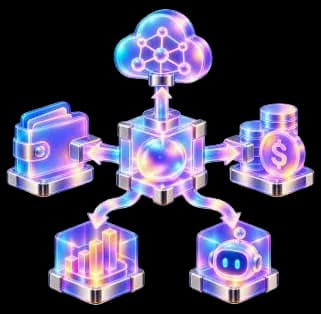
  4. A settlement network linking the cloud and a wallet

    Pay connects value

    AiLGNS Pay

    Value routing and settlement for AI services

    Covers quoting, authorization, execution, metering, acceptance, settlement and revenue sharing, recording the value of AI services in one place.

  1. Discover
  2. Invoke
  3. Compose
  4. Execute
  5. Verify
  6. Meter
  7. Settle

Ecosystem plans do not mean these products or entry points are live. Chapter 3 of the whitepaper is authoritative.

Two helices, one economy.

HELIX does not merge protocol and market into one control system. It splits them into two economic engines with different jobs that stay coupled: one controls how far the economy can expand, the other discovers where capital should go.

Whitepaper p. 43

HELIX-P

Protocol Coordination Engine

How far can the economy expand?

  • Supply
  • Emission bounds
  • Power activation
  • Reserves
  • POL
  • Liquidity capacity
  • Risk

Path

  1. Reserve
  2. Power
  3. Emission
  4. Turbine
  5. LSP
  6. Liquidity
  7. Capacity
  8. Feedback
Role
Defines the feasible set
Goal
Stability + Solvency + Sustainability
Boundary
Cannot force all emission into any single pool
  • Emission
  • Liquidity
  • Fees
  • Price

HELIX-M

Market Autonomy Engine

Where should capital flow?

  • Emission direction
  • LP allocation
  • ve voting
  • Market competition

Path

  1. AiLGNS
  2. veAiLGNS
  3. Vote
  4. Gauge
  5. LP
  6. Trading
  7. Fees
  8. Governance
Role
Optimizes within the feasible set
Goal
Efficiency + Yield + Capital Allocation
Boundary
Cannot win unlimited emission through votes alone

Emission is decided where the two helices meet

Eᵢ(actual) = min( Eᵢ(vote), Eᵢ(max) )

Votes say how much the market wants. The protocol works out the most it can give from budget, real liquidity, trading and risk. The smaller of the two wins.

Four-layer control loop

  1. Boundary
  2. Autonomy
  3. Feedback
  4. Adaptation
The market decides how much it wants; the protocol decides the most it can give.

Limited supply, controlled emission.

AiLGNS is HELIX's core economic asset, linking Power, Turbine, veAiLGNS, Gauge and the liquidity markets. Its supply cap does not grow with users, Power or the size of the ecosystem.

Whitepaper p. 67

210,000,000

AiLGNS max supply

Economic Growth ≠ Unlimited Token Growth
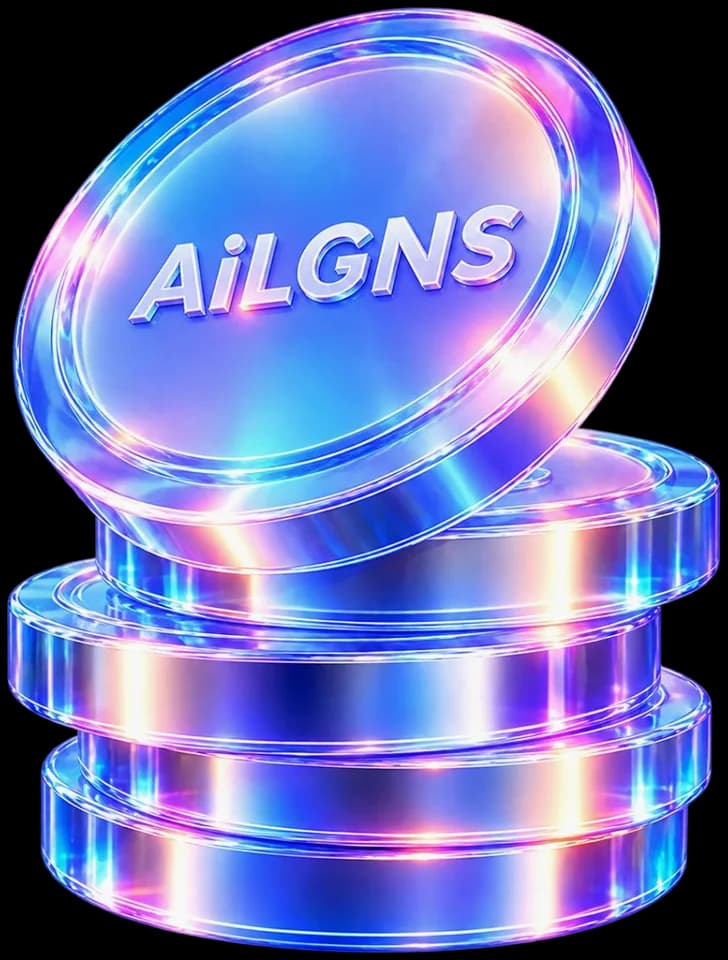
A stack of holographic glass AiLGNS tokens

Supply has a cap. Burning has a floor.

Effective Supply = 210,000,000 − Cumulative Burn

21,000,000

Final minimum supply · solid part

Min Remaining Supply

189,000,000

Max cumulative burn · gradient part

Max Cumulative Burn

210,000,000

Issuance cap · whole bar

Max Supply

Budgets set the ceiling.
The economy sets the release.

Community emission and DAO incentives each run for 520 Epochs (1 Epoch = 7 days; about 10 years in total) across five phases. Every phase budget is a ceiling, not a target.

Whitepaper p. 70

Whitepaper budget caps · not actual emission

  • Community emission cap / Epoch
  • DAO incentive cap / Epoch

The step curve is the whitepaper's budget cap for each Epoch. Drag, or use the arrow keys to move one Epoch at a time; hold Shift to jump 10.

Epoch 1

Year ≈ 0.0 · Launch

Community cap / Epoch
220,500
DAO cap / Epoch
Not started
From Epoch 11
Cumulative community budget cap
220,500
Actual emission / Epoch
No dataPending launch
  1. Launch

    7%

    Epoch 1–52

    Community budget
    11,466,000
    DAO budget
    1,470,000
  2. Acceleration

    24%

    Epoch 53–162

    Community budget
    39,312,000
    DAO budget
    5,040,000
  3. Expansion

    30%

    Epoch 163–297

    Community budget
    49,140,000
    DAO budget
    6,300,000
  4. Maturity

    23%

    Epoch 298–412

    Community budget
    37,674,000
    DAO budget
    4,830,000
  5. Decline

    16%

    Epoch 413–520

    Community budget
    26,208,000
    DAO budget
    3,360,000

All five phases · Community 163,800,000 · DAO 21,000,000 AiLGNS

Three gates

Actual release is the lowest of three gates. When any one of them tightens, that period's release tightens with it.

E(Actual) = min[ E(Token), E(DAI), E(Capacity) ]

Schematic: the lowest of three gates wins

TokenE(Token)

DAIE(DAI)

CapacityE(Capacity)

Token hard cap

The phase budget cap for each Epoch.

E ≤ E(Token)

DAI value gate

The DAI value allowed this period ÷ the effective AiLGNS price.

E(DAI) = V(DAI) / P

Economic capacity gate

Release only as much as the market can absorb.

E(Capacity) = f(Liquidity, Demand, Absorption, Risk)
  • Budgets are set per Epoch; release settles daily at 00:00 SGT
  • Each daily release: 50% Personal Power / 50% Community Power
  • Unused community budget goes 50% to the DAO incentive reserve and 50% to the insurance reserve. It never returns to the community
  • After Epoch 520, any DAO reserve left keeps releasing in Phase VI

Five pools to start. Not five pools forever.

AiLGNS starts from a base network of five official liquidity pools. Three routers send emission, buys and sells to different pools: capital can leave, liquidity stays.

Whitepaper p. 113
Schematic · routing direction, not actual flowGaugeTurbineLSP

Three routers · 5 official pools

  • Gauge= Emission allocation
  • Turbine= Buy-flow allocation
  • LSP= Sell-flow allocation

Gauge LP exit: 95% goes back to the user, 5% stays as protocol-owned liquidity (POL)

95% back to the userKept as POL 5%
Capital can leave. Liquidity stays.POL(t+1) = POL(t) + PlanPOL + ExitPOL + OtherPOL

The five official pools

Pending launch
  • AiLGNS / DAIMain poolCore price discovery and DAI liquidity
  • AiLGNS / LGNSSatelliteConnects the LGNS ecosystem
  • AiLGNS / GLGNSSatelliteConnects the GLGNS ecosystem
  • AiLGNS / USDTSatelliteExtends stablecoin liquidity
  • AiLGNS / ASatelliteConnects the A ecosystem

Time proves long-term commitment. Burning proves permanent commitment.

AiLGNS has two ways into governance: lock it for an ordinary veNFT that expires, or burn 100% of it for a permanent veNFT. 1 Effective veAiLGNS = 1 Vote; permanent governance gets no extra multiplier.

Whitepaper p. 95

Time lock

Ordinary veNFT

The longer you lock, the more initial voting power you get. Voting power decays linearly with the time left, and the full amount comes back at expiry.

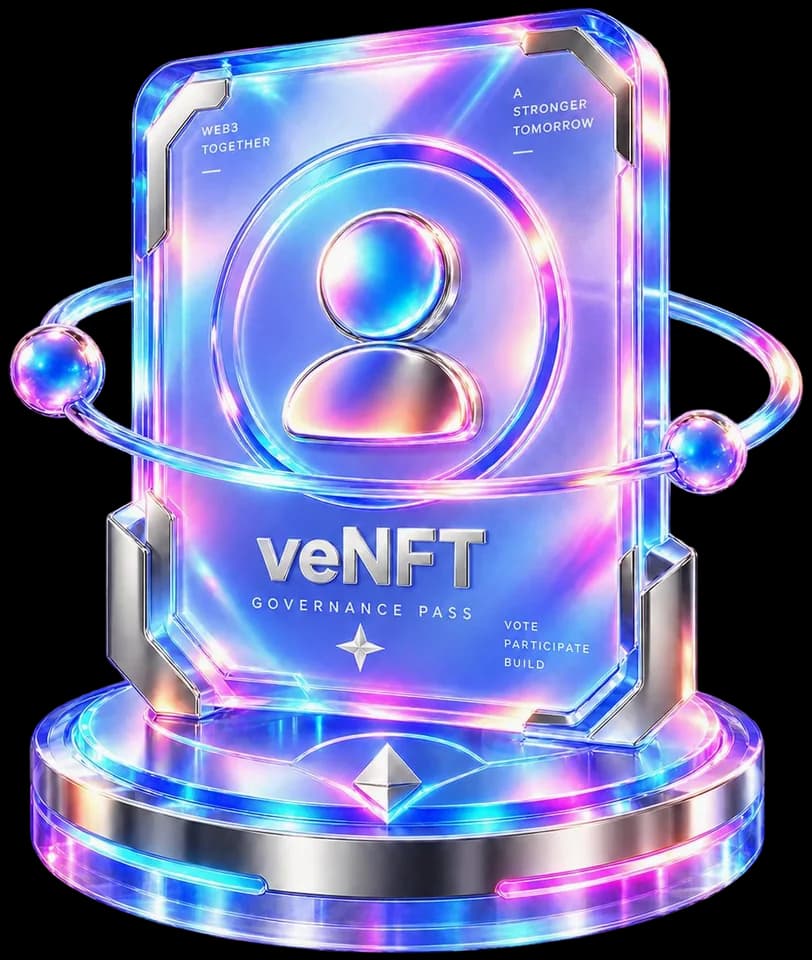
Ordinary veNFT governance credential: a holographic glass card floating above a base, circled by an orbit
Lock period
5 to 208 Epochs
Voting power
Locked amount × remaining Epochs ÷ 208, decaying linearly
Expiry
100% of the AiLGNS comes back

Standard tiers · Epochs / approx. duration

  • 535 days
  • 266 months
  • 521 year
  • 1042 years
  • 2084 years
Voting Power = Locked AiLGNS × Remaining Epoch ÷ 208

Permanent burn

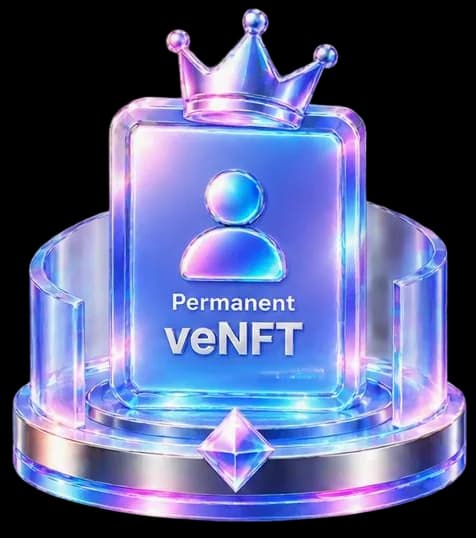
Permanent veNFT

Burn 100% for voting power that never expires. Permanent does not mean full weight forever.

Permanent veNFT governance credential: a crowned holographic glass card standing on a ring-shaped base
Convert
1 AiLGNS burned = 1 permanent veAiLGNS
Weight
100% for the first 208 Epochs, then down 1 percentage point per Epoch, to a floor of 35%
Principal
Not redeemable
Caps
Permanent governance capped at 30% of the total; no more than 2% added per Epoch
Burn cap
At most 189,000,000 AiLGNS in total
One way
Ordinary → Permanent. A permanent veNFT cannot convert back to an ordinary one
W = max[35%, 100% − (t − 208) × 1%] (t > 208)

Voting power simulator

Enter an amount, pick a path and a tier, then drag along the curve to see voting power at any Epoch.

Whitepaper model projection · contracts are authoritative

AiLGNS

Whole numbers 1 to 210,000,000 · arrow keys ±1,000

Governance path

Lock tier · Epochs

104 Epochs ≈ 2 years

Time lock · 104 EpochsCompare: permanent burnx: Epoch · y: veAiLGNS

Drag, or move the cursor with the arrow keys; hold Shift to move 10 Epochs at a time. Time-locked voting power decays linearly to zero at expiry; permanent governance keeps full weight for the first 208 Epochs and reaches its 35% floor at Epoch 273.

Initial voting power
5,000
veAiLGNS · Epoch 0
Voting power at cursor
2,500
veAiLGNS · Epoch 52
Returned at expiry
10,000
AiLGNS · at Epoch 104
Weight at cursor
25%
Remaining Epochs ÷ 208

Governance rewards: trading fees from the pools you vote for · voting incentives · 1% AiLGNS Sell Fee → veAiLGNS

Permanent Governance ≠ Permanent Full Weight

Every economic boundary, observed live.

Once the HELIX protocol launches, these modules will read state straight from the chain. For now they show the question each one answers, the formula behind it, and the boundaries the whitepaper sets.

Whitepaper p. 136
Pending launch

Economic load ratio

ELR

How much new emission can the market still absorb?

0%60%80%100%

No data%

Pending launchNeedle · awaiting signal · schematic
EconomicLoad
No data
C_Global
No data
ELR historyRecording starts at launch
  • Healthy≤60%
  • Controlled60–80%
  • High load80–100%
  • Overload>100%
ELR = EconomicLoad / C_Global

V1 reference thresholds, adjustable by governance

Daily settlement clock

00:00 SGT

How long until the next Power settlement?

Current time SGT · UTC+8
--:--:--
Until the next 00:00 SGT
--:--:--

Power settles daily at 00:00 SGT · in effect once HELIX launches

Cumulative burn

How far is supply from its final minimum?

No data/ 189,000,000
  • Burnable cap90%
  • Final minimum supply21,000,000
Pending launchEffective Supply = 210,000,000 − Cumulative Burn

Gauge health score

HealthScore

What is the most incentive this pool can receive?

No data/ 100

Pending launch
L30%V20%F20%P20%S10%
Sweep is schematic

L Real liquidityV Real volumeF Fee efficiencyP Price stabilityS Capital stability

HealthCap

  • 80–100100%
  • 60–8080%
  • 40–6050%
  • <400%
HealthScore = 0.30L + 0.20V + 0.20F + 0.20P + 0.10S

Risk state machine

Which protection level is the system in right now?

No data

Inactive
  1. GreenNormal operation
  2. YellowEarly-warning contraction
  3. RedActive contraction
  4. BlackEmergency protection

Emission cut

100%80%50%20%0%

Step-by-step recovery

0%20%50%80%100%

TotalSellFee = 3% + ProtectionFee ≤ 28%
Risk control shield

Triple emission gates

How much emission can this period actually release?

E(Token)No data
E(DAI)No data
E(Capacity)No data
minE(Actual)Loading bars are schematic

No dataAiLGNS / Epoch

Pending launch

First budget phase · Launch · cap 220,500 AiLGNS / Epoch

E(Actual) = min[E(Token), E(DAI), E(Capacity)]

Active Power

Power lifecycle

How much Power across the network is Active right now?

No dataDAI

Pending launch
  1. New
  2. Active
  3. Completed
Power(DAI) = Recognized Contribution(DAI)

POL and reserves

Protocol-Owned Liquidity

How much protocol-owned liquidity and reserve has built up?

No dataDAI

Pending launch

Reserve ledgers

  • Core
  • Insurance
  • Ecosystem
  • Community Development Fund

Reserve ≠ Guaranteed Price Floor
Reserves are not a guaranteed price floor.

Protocol reserve vault
POL(t+1) = POL(t) + PlanPOL + ExitPOL + OtherPOL

LSP inventory coverage

How many days of safe settlement can the LSP inventory still cover?

No datadays

Pending launch

Execution window

Execution window: standard cycle 24 hours, at most 48 hours.

Safe settlement capacity is set by governance

InventoryCoverage = LSPInventory / SafeSettlementCapacity

From Origin, to AWAKE,
and on to Eternal.

Every completed cycle leaves the economy changed. It is not a closed circle but a spiral that climbs.

Whitepaper p. 18
  1. Phase I · Complete

    ORIGIN

    Connect people

    Building reach: gathering users, capital and communities worldwide into a network of strong consensus and long-term participation.

    1. People
    2. Community
    3. Consensus
    4. Network
  2. Phase II · In progress

    AWAKE

    Connect intelligence, value and capital

    Building the ecosystem: AI as the core ecosystem business, HELIX rebuilding the protocol economy, and a global intelligent economy on top of both.

    1. AI Service Economy
    2. HELIX Protocol Economy
    3. AI Capital Network
    • Genesis Plan raise completeSep 15–19, 2026 · UTC+8
    • HELIX protocol · Pending launch
  3. Next phase · to be revealed

    ETERNAL

    The whitepaper leaves only a name.

Each evolution repairs what the last generation left behind

Asset → Consensus → Measurement → Allocation → Coordination

  1. OHM

    Growth should leave assets with the protocol

  2. Origin

    A protocol needs a strong-consensus community governing together

  3. Curve Wars

    Where emission goes is itself economic power

  4. ve(3,3)

    Governance can be a tool for allocating capital

  5. HELIX

    Protocol coordination ⊗ market autonomy

A circle only repeats.
A spiral learns from repetition
and moves forward through every cycle.

Cycle + Memory + Adaptation = Evolution

From Origin, to AWAKE, and on to Eternal. HELIX does not promise a market that only goes up. It holds to one principle: the protocol sets the boundary, the market finds the equilibrium.

Read the whitepaperHELIX protocol · Pending launch

Before you enter

This site is built independently by one person. It shows public data from the Anubis chain and explains the protocol rules for study and research only. Nothing here is investment advice.

  • Unofficial: it does not speak for the AWAKE HELIX project team
  • No wallet connection, no transactions, never asks for keys or seed phrases; the only transfer is paying for a membership you choose to buy under My account
  • Visits record your IP, device and the pages you open; if you register, your notes, groups, tracked addresses and recent lookups are stored on this site's server, and every sign-in records your IP and device
  • Data is read straight from on-chain contracts and the rules follow the whitepaper; official announcements and contracts always prevail
  • The HELIX protocol has not launched yet; related figures are whitepaper model projections
  • Crypto assets are extremely volatile and you can lose your entire principal
Read the full terms
  1. A personal project, not an official siteThis site is built and maintained independently by one person for study, research and information only. It is not an official AWAKE HELIX Protocol website and does not represent the project team; membership fees go to the operator of this site, not to the project. Every visit records your IP address, device and the pages you open, kept for 90 days. If you register, your notes, groups, tracked addresses and recent lookups are stored on this site's server. Every sign-in records your IP address and device.

  2. Read-only on chain, never touches your walletThis site only reads the blockchain: it does not connect to wallets, never requests a signature, never sends a transaction, never asks for a private key, seed phrase or wallet password in any form, and never sends you direct messages. The one transfer it involves is a membership payment: you sign in, choose to create an order on the My account page yourself, then send the exact amount shown on that order page to the receiving address shown on that same page, from your own wallet. Any other request in this site's name to transfer, sign or hand over a key is a scam. To transact, use the official dApp (anubis.origindefi.io).

  3. Data sources and accuracyOn-chain data is read directly from contracts on the Anubis chain and can lag briefly because of node delays or indexer syncing. Rules and guides are based on the public AWAKE HELIX Protocol Whitepaper V1.0 and the official pages, and may contain misreadings or omissions. The project's official announcements and the contracts as finally deployed always prevail.

  4. The HELIX protocol is pending launchThe HELIX protocol modules, including the AiLGNS token, emission, the five pools and ve governance, are not deployed on-chain yet. Every related figure on this site is a whitepaper model projection, not live data; the contracts will be authoritative.

  5. Not investment adviceNothing on this site, including data, charts, model projections and commentary, is investment advice, an offer, a solicitation or a promise of returns, or a recommendation of any token or project.

  6. Risk and complianceCrypto asset prices are extremely volatile and you may lose your entire principal. There are further risks such as contract bugs, thin liquidity and regulatory change. Make sure the laws where you live allow you to use this site, judge for yourself and accept the consequences.


This browser will remember your choice. We will ask again if the terms change.